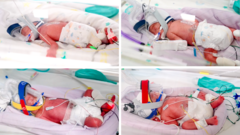
# Rare Identical Quadruplets Born in Australia
A family in Australia welcomed four naturally conceived identical quadruplets, an extraordinarily rare occurrence that left their parents in shock. The hospital caring for the family described the parents as taken by "immense surprise" upon learning they were expecting four babies, let alone identical ones.
The chances of conceiving identical quadruplets without fertility treatment are extraordinarily low. While fraternal multiples can result from multiple eggs fertilizing during a single cycle, identical multiples develop from a single fertilized egg that spontaneously splits. For this splitting to produce four viable identical infants represents odds so remote that such births rarely make medical literature.
The natural conception of these quadruplets makes the case even more unusual. Most multiple births of this magnitude result from assisted reproductive technologies like in vitro fertilization, which increase the likelihood of hyperovulation or embryo manipulation that can lead to multiples. The spontaneous division of one embryo into four separate individuals happens through biological processes not yet fully understood by reproductive scientists.
Hospital staff noted the family's astonishment, which reflects how unexpected and medically uncommon this event truly is. Parents carrying multiples face elevated risks during pregnancy and delivery, including gestational diabetes, preeclampsia, and preterm birth. Healthcare teams managing identical quadruplets must monitor each fetus closely, as identical multiples sometimes develop twin-to-twin transfusion syndrome, a condition where blood vessels connect between fetuses.
The successful delivery of four healthy identical babies represents a remarkable medical outcome. While the hospital report did not detail the specific circumstances of the birth or the health status of the infants, the fact that the story merited attention from major health news sources like the BBC underscores how medically exceptional naturally conceived identical quadruplets remain. The Australian family's experience offers a rare glimpse into one of reproduction's most statistically improbable events