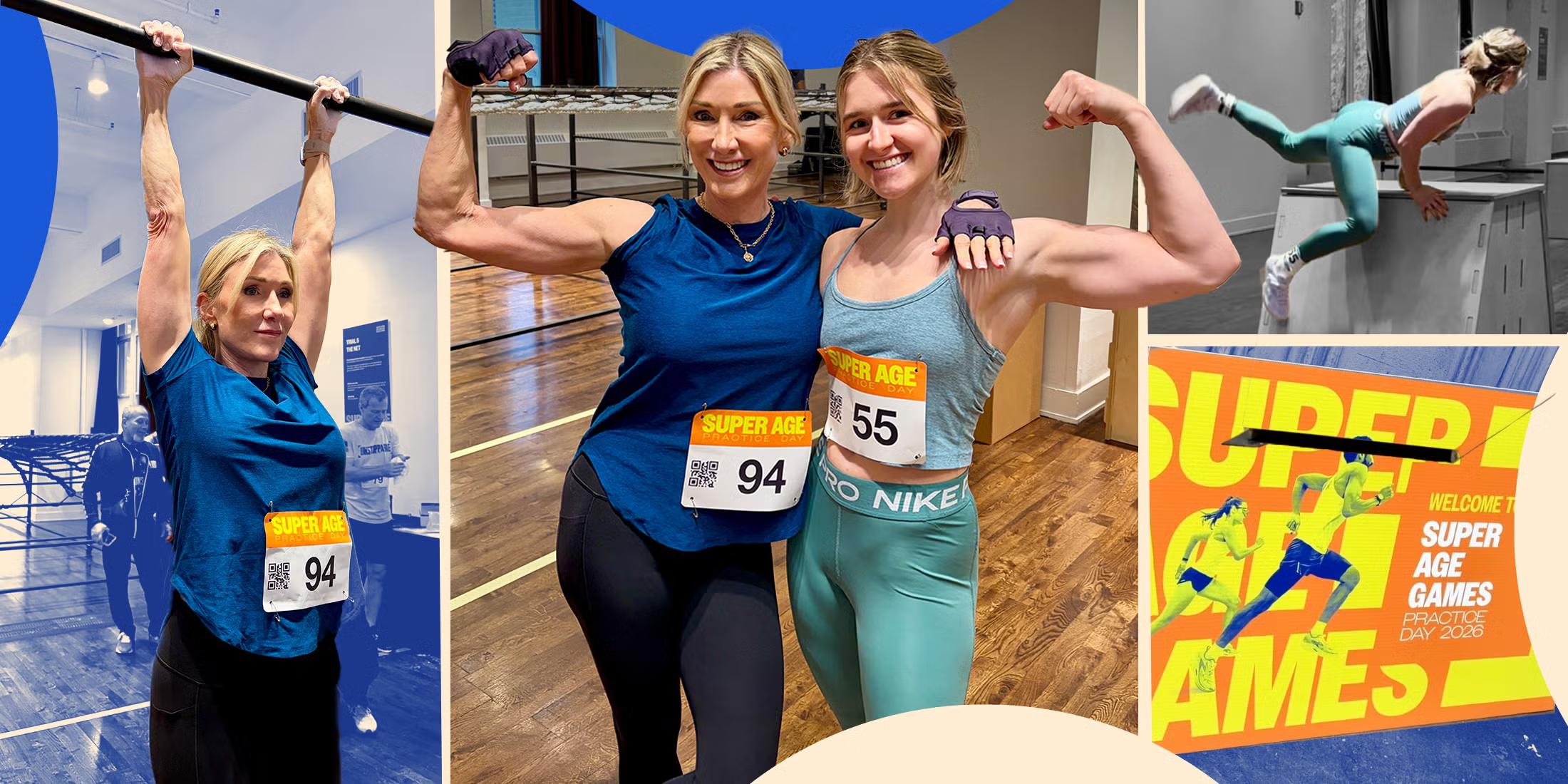
The Super Age Games, a live longevity fitness competition that took place in New York City on November 7, bills itself as a tool to help participants gauge how long they'll live well. The event centers on eight fitness trials designed to test markers that predict longevity: grip strength, aerobic capacity, agility, balance, functional strength, memory, and relational capacity.
A journalist and her 64-year-old mother attended a practice day at the competition to test the eight challenges. Both women were experienced gym-goers who did a few days a week of strength training and cardio, but had not trained specifically for these trials.
In the agility challenge, participants jumped over and crawled under gates set 10 meters apart to test explosive movement and gait speed. The journalist finished in 80 seconds, her mother in 73 seconds. Their feedback indicated agility above average and recommended adding jumping exercises like directional hops and line drills.
The memory trial required participants to track specific balls moving on a screen during a six-minute NeuroTracker cognitive training tool. Aashaun Khedaru, exercise physiologist supervisor at the Sports Performance Center at NYU Langone Health, suggested taking aerobic exercise seriously for improved cognitive function. The feedback recommended brisk walking for 30 minutes, three to five times a week, paired with memory or reaction games.
For the balance test, participants walked forward and backward on a 12-foot balance beam while carrying a 10-pound water-filled tube, aiming to use as few steps as possible. The journalist completed it in 49 steps, her mother in 30 steps.
Super Age feedback came from work with the Buck Institute for Research on Aging, performance coach Andy Walshe, PhD, and their head trainer, according to Heather Hurlock, founding editor at Super Age. All participants received personalized longevity training tips based on their performance.